

Spesa Restores Retaining Walls at the Old Synagogue in Hohenlimburg
Preserving Historic Landmarks Meets Slope Stabilization
- Renovation of two dilapidated retaining walls at the Old Synagogue in the Hohenlimburg, Germany, on behalf of the Wirtschaftsbetriebe Hagen
- Demolition, restoration of the historic material, and reconstruction of the walls in accordance with historic preservation guidelines
- Additional slope stabilization using shotcrete and anchors
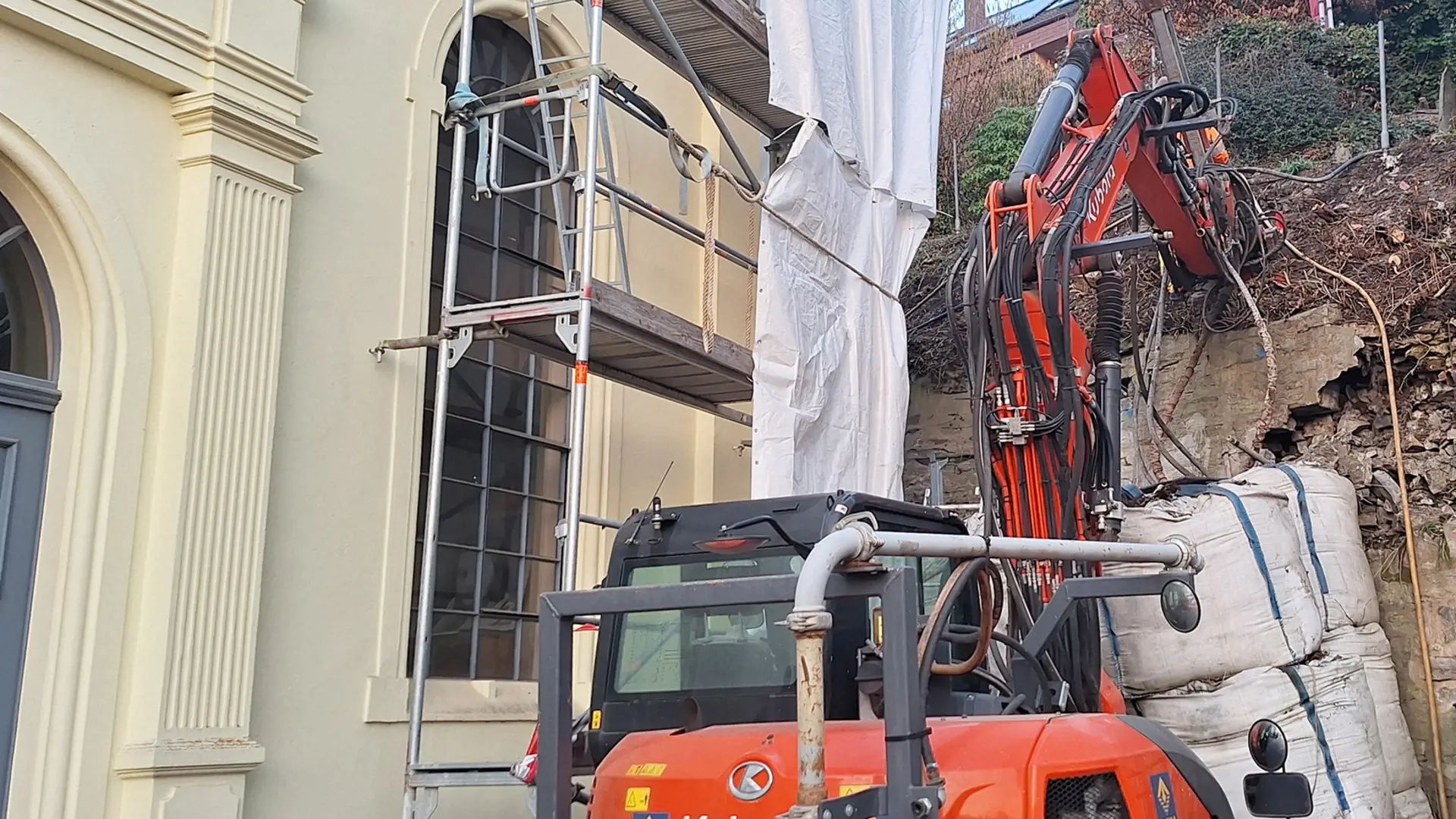
Hagen, Germany – Perched high above Hohenlimburg, a district of Hagen, the Old Synagogue, built in 1870, stands as an important site of remembrance for Jewish history in the southeastern Ruhr region. Today used as a museum and event venue, the historic building impresses with its exposed location on a narrow hillside terrace. Two retaining walls secure the slope with an incline of up to 40° and the adjacent embankments. However, the past decades have left their mark on the historic masonry: During a structural inspection, the tilt of one of the retaining walls was detected, posing a risk to structural stability. In addition, a section of the wall has already collapsed. Large bulk bags are temporarily stabilizing the structure. To permanently restore the structural stability of the two retaining walls, Wirtschaftsbetrieb Hagen AöR (WBH) commissioned SPESA Spezialbau und Sanierung GmbH to completely dismantle the existing retaining walls, stabilize the slope, and subsequently reconstruct the historic masonry in accordance with heritage preservation guidelines.
Geotechnical Challenges
A materials assessment confirms that, due to the extent of deterioration, restoration is only possible as part of a complete demolition and reconstruction. While the first retaining wall supports the terrain break, including the adjacent slope, and has already partially collapsed, the second wall directly borders the southeast annex of the synagogue. The bulk bags used as emergency support between the wall and the synagogue prevent the damage from spreading but significantly restrict the work area. “They currently provide the necessary structural support and can therefore only be removed step by step,” explains Sebastian Otto, Site Manager at Spesa. “At the same time, they pose an additional logistical challenge in the confined work environment.”
Renovation under heritage preservation regulations
Since the two retaining walls were not constructed as load-bearing, heavy-duty walls but merely serve as a facing for the stable rock behind them, dismantling them is straightforward. The existing damage is therefore primarily attributable to weathering processes in the upper rock layers as well as root pressure. As part of the restoration, the existing natural stone material is first carefully removed. “The stones will be secured in accordance with heritage preservation requirements, temporarily stored, and prepared for reinstallation,” says Sebastian Otto. Due to the limited space on site, storage poses logistical challenges. However, a detailed mapping of the individual stones is not required.
Slope Stabilization as the Basis for Reconstruction
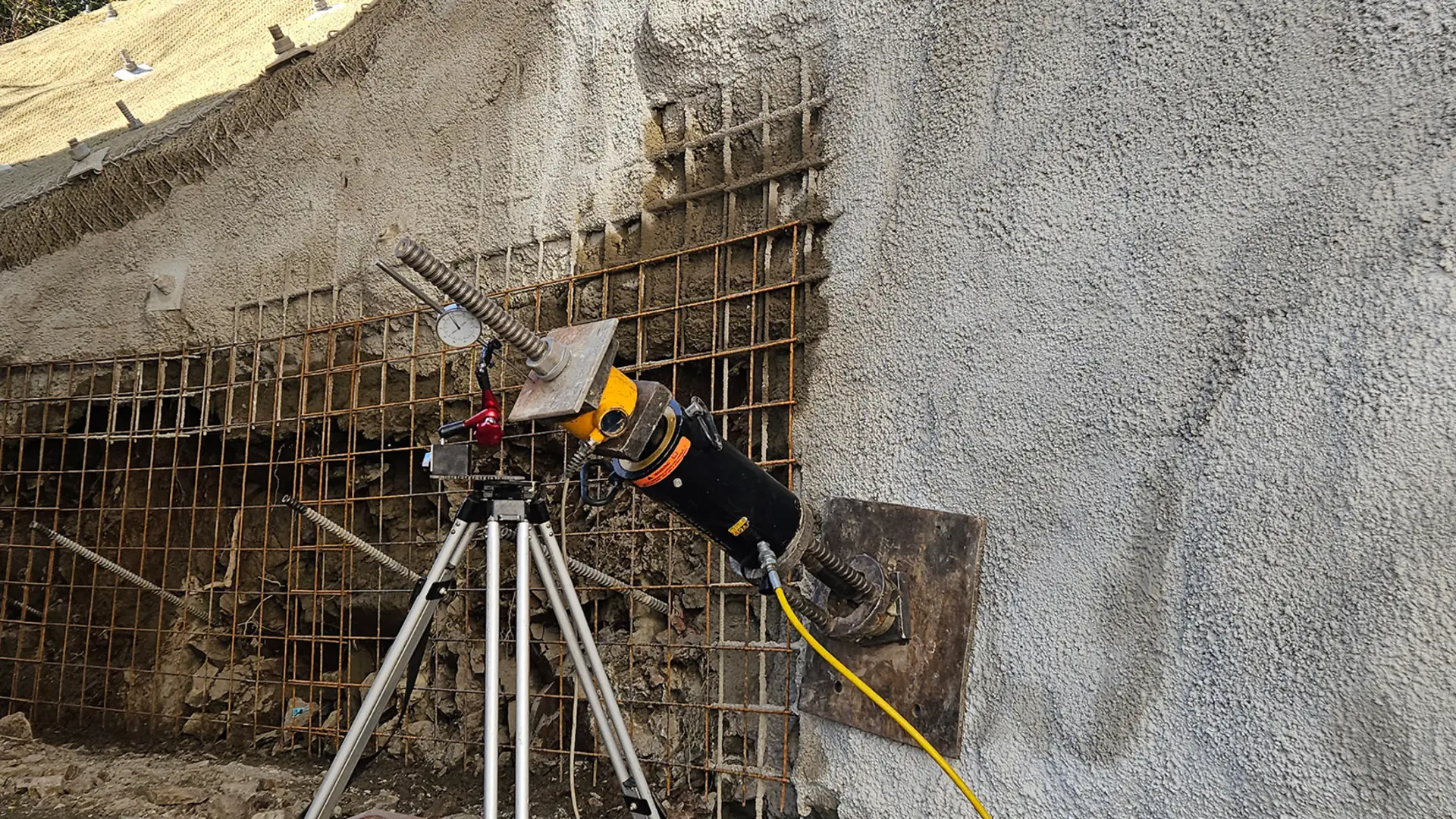
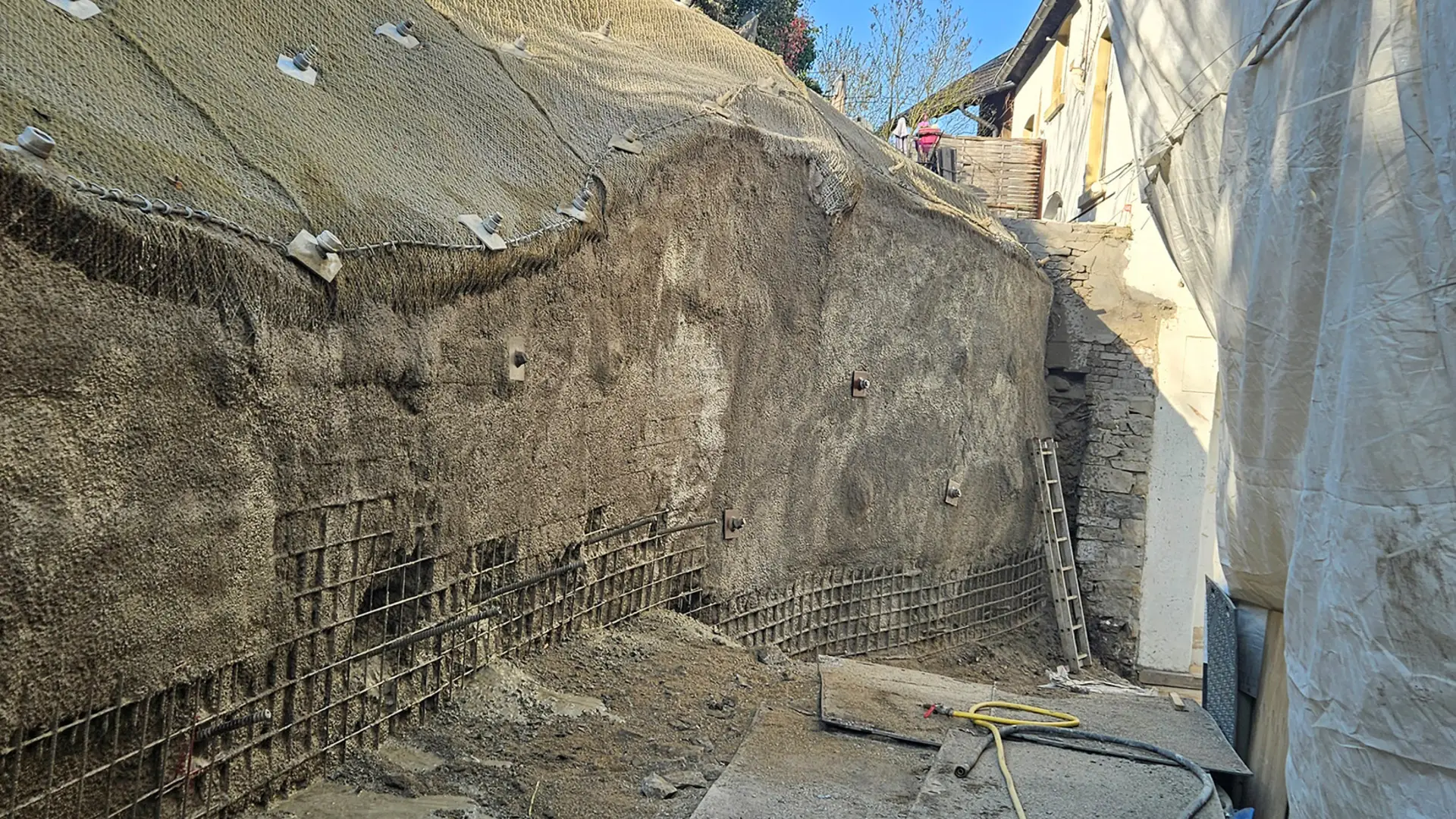
After demolition, the slope is secured by applying a shotcrete shell using drilling and excavator rigs. On an area of approximately 150 m², 75 tons of shotcrete are applied and additionally secured with 110 anchors. Only after completion of this load-bearing slope stabilization system will reconstruction of the retaining walls begin using the original historic stone material. Existing brickwork discovered on site will not be reused; instead, all sections will be rebuilt exclusively with natural stone. Missing stones will be replaced with comparable, locally sourced natural stone to preserve the historical appearance. The space between the shotcrete shell and the natural stone masonry is then filled layer by layer with single-grain concrete. “This method allows us to precisely control the pressure exerted by the fresh concrete,” says Sebastian Otto. “The new natural stone wall does not serve a load-bearing function for the slope. It supports only its own weight and the pressure of the drainage layer.”
Visual enhancement and long-term structural stability
The combination of confined site conditions, heritage preservation requirements, and the need to leave the bulk bags in place as temporary support elements makes this renovation project a logistical and technical feat requiring precision. The focus is as much on treating the historic surroundings with care as it is on permanently restoring structural stability. Work began in February and is expected to be successfully completed in July 2026. With this restoration, Spesa is making an important contribution to preserving this culturally significant site while creating a safer and visually enhanced environment for visitors.
Press Image
Download
Your Contact